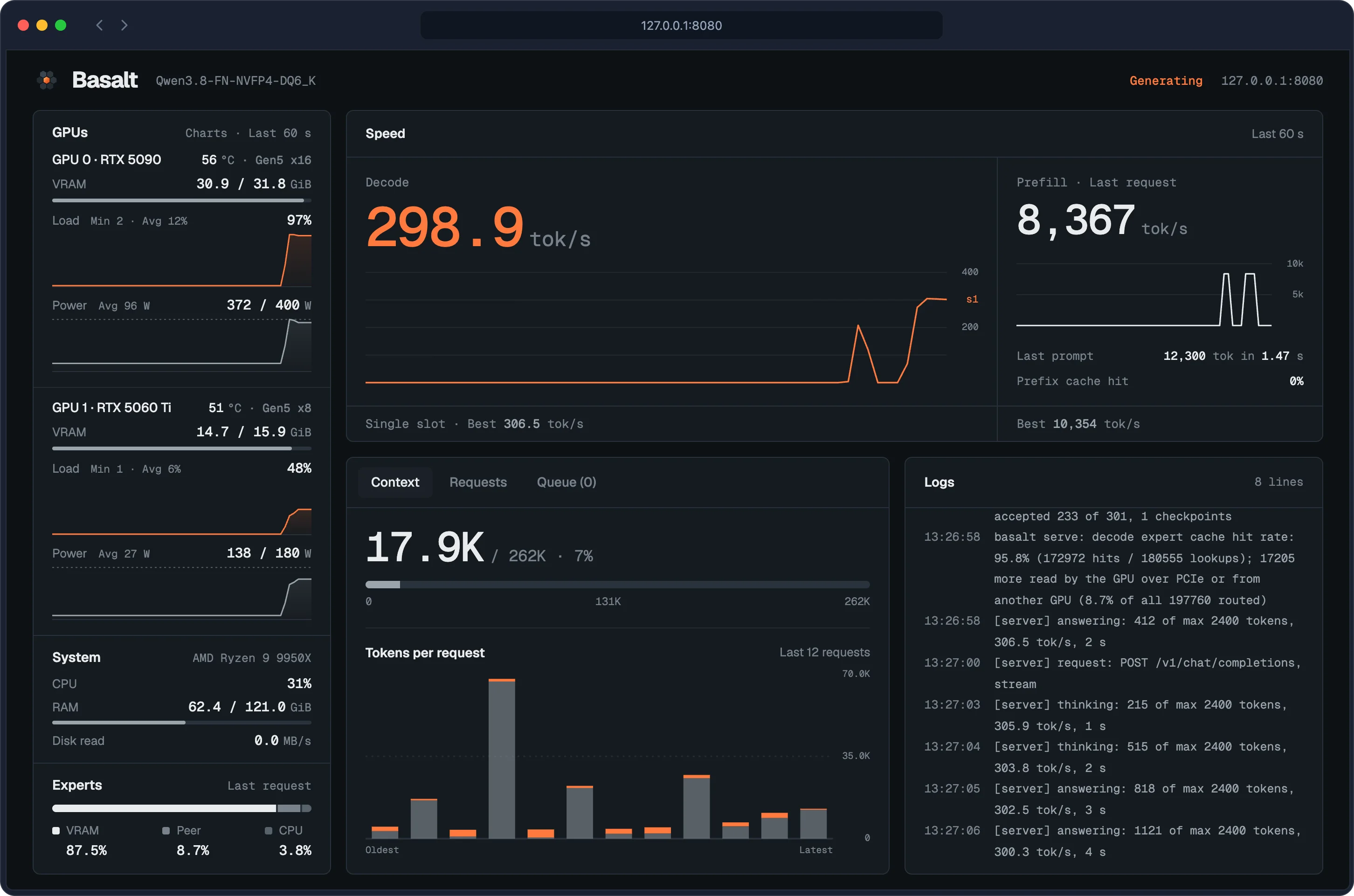
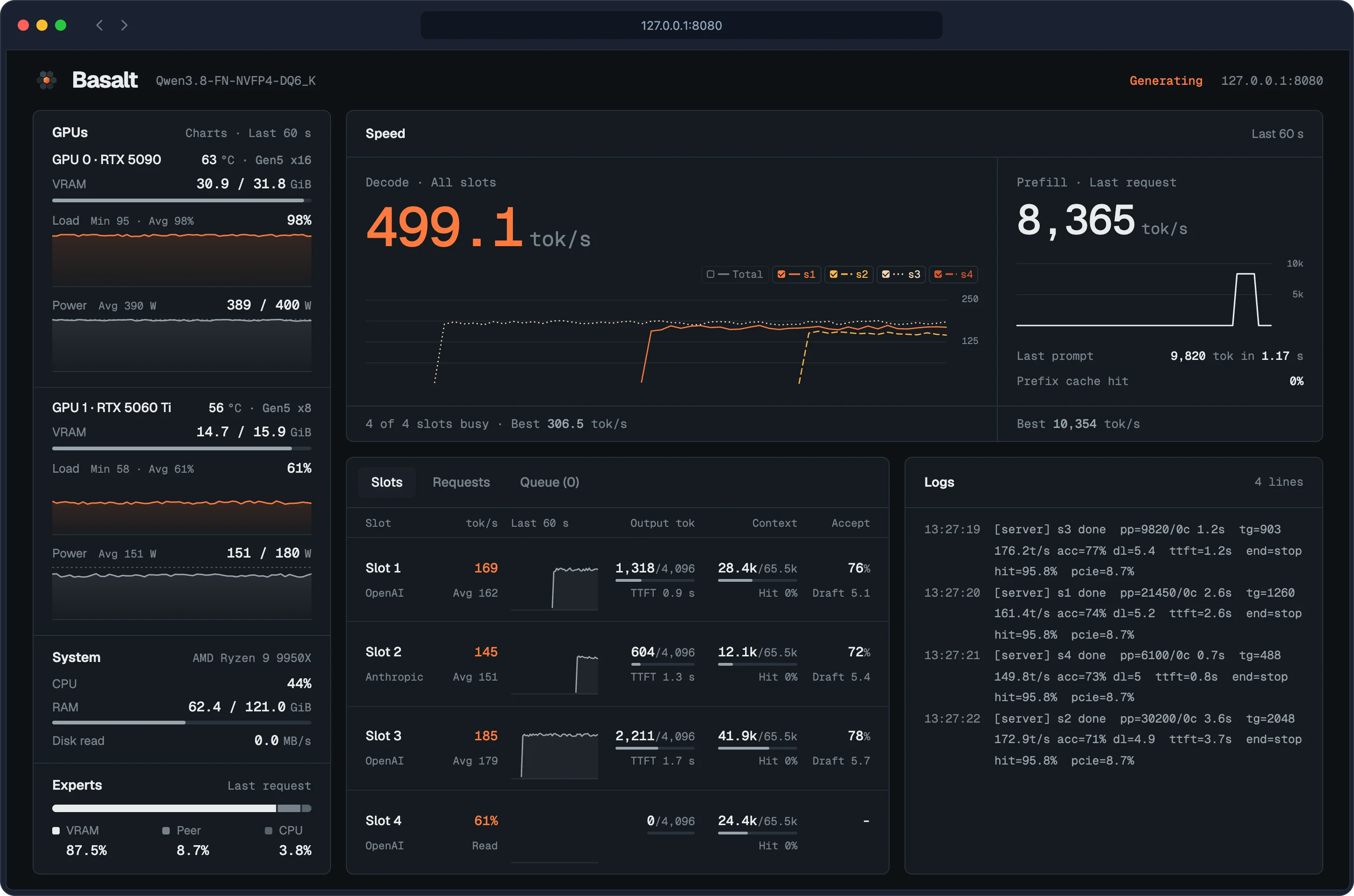
What is Basalt?
A local inference engine on NVIDIA Blackwell GPUs. It runs Qwen3.8-Flash-Next, DeepSeek-V4.1-Flash, Qwen3.8-27B, Hy4-flash and Inkling 2 Mini and speaks the OpenAI and Anthropic APIs.
Which GPUs does it support?
NVIDIA Blackwell (sm_120) with CUDA 13, on Linux and Windows x64. Community runs include the RTX 5090, 5080, 5070 Ti, 5060 Ti and the RTX PRO 4000 and 6000 Blackwell.
Which models does it run?
Qwen3.8-Flash-Next, DeepSeek-V4.1-Flash, Hy4-flash and Inkling 2 Mini (mixture-of-experts) and Qwen3.8-27B (dense), each with packs on Hugging Face. Every model takes image input. Context goes up to 262,144 tokens on Flash-Next and the 27B and 1,048,576 on DeepSeek, Hy4-flash and Inkling 2 Mini.
How fast is it?
Fast, and it stays fast when a model spills onto a second GPU or into system RAM. Prefill (reading the prompt) is a particular strength. Speeds depend on the model, the hardware and the context length, so the real figures are on the community runs page, measured on people's own machines.
How does Basalt compare to other engines?
In a seven-engine comparison with identical requests, Basalt had the highest decode speed in every request and the highest prefill at long prompts. The full tables, with how they were measured, are on the benchmarks page, and real-world numbers are on the community runs page.
Can it use a second GPU or system RAM?
Yes, for Qwen3.8-Flash-Next, DeepSeek-V4.1-Flash and Hy4-flash: what does not fit on the main card goes to extra GPUs (up to three for Flash-Next and Hy4-flash, one for DeepSeek) and to system RAM. Inkling 2 Mini keeps experts in system RAM on one card, and Qwen3.8-27B runs on one card.
Does it support tool calls and structured output?
Yes. Tool calls and JSON schemas are enforced by a grammar while decoding, on by default. Output cut off by max_tokens can still be incomplete.
Is it open source?
Yes, MIT licensed, at github.com/jesdga95/basalt. Build it, download a pack from Hugging Face and run bin/basalt serve --config basalt_config.json.